
Consent Management Platform (CMP) in 2026: What It Is and 7 Live Checks That Matter
When people search for consent management platform (cmp, they are often chasing an answer to a bigger systems question: where does consent logic live, how does it propagate, and what breaks when the stack changes underneath it?
Use the linked DataShyre references for surrounding context, then focus on implementation flow, technical dependencies, and release checks that keep the control path stable.
That is the difference between a banner tool and a real control layer.
If you want nearby context first, start with these guides to consent management platforms, consent management provider, and cookie consent manager. This page is narrower. It is the seven-check review I would use this week to decide whether a consent management platform (CMP) is actually doing the job.

What a consent management platform actually has to do
In real deployments, a real consent management platform (CMP) has to handle five things at once:
- present a fair and understandable first-layer choice;
- hold optional technologies back until the right signal exists;
- pass consent changes into the runtime fast enough to matter;
- support the regional branch the site actually needs; and
- leave behind records another team can still verify later.
This is why the regulatory and platform materials still point to operations, not cosmetics.
The European Commission says valid consent must be tied to a specific purpose, must be clear, and must use “clear and plain language.” The same page also says withdrawal must be possible in a way that is “as easy to use as giving consent.” CNIL’s current dark-pattern notice stays just as direct: rejecting cookies should be “just as easy as accepting them.” The ICO’s finalized storage-and-access-technologies guidance, updated on April 29, 2026, is also useful because it makes clear the review surface is broader than classic cookies alone. It expressly covers things such as tracking pixels, scripts or tags, device fingerprinting, and web storage.
That broader scope is why I would not judge a consent management platform (CMP) by banner copy alone.
1. Check whether the first-layer choice is fair
Start with the screen the visitor actually sees.
Many CMP evaluations still begin in the admin console. That is too late.
The first test is whether the initial choice is fair enough to support valid consent at all. The European Commission’s language on visibility and clarity matters here, and CNIL’s warning about deceptive banner design matters even more in day-to-day reviews.
So inspect the first layer on desktop and mobile:
- is
Reject allvisible whereAccept allis visible; - are categories and purposes written in plain language;
- is the privacy-protective path easy to find without extra hunting;
- do button color, size, or placement push the person toward one path.
If a consent management platform (CMP) fails at the first layer, the rest of the feature list usually matters less than the sales page suggests.
2. Check prior blocking on the pages most likely to leak first
A CMP is not doing much if it records a preference after optional tools have already acted.
This is where the ICO’s 2026 guidance is particularly helpful. Because it addresses storage and access technologies broadly, it pushes you to review more than obvious cookies. A consent management platform (CMP) should help stop optional scripts, pixels, tags, and similar technologies from acting before the correct choice exists where prior consent is required.
That means the homepage is not enough. Test the templates most likely to leak first:
- landing pages with analytics and advertising tags;
- product pages with personalization or experimentation scripts;
- article templates with embedded video or social media widgets;
- pages running chat, heatmaps, or session replay tools;
- cached or tag-manager-heavy templates.
If the platform only documents consent while the runtime moves first, it is not really controlling anything.
3. Check timing, not just stored state
This is where a surprising number of CMP setups still fail.
Google’s current consent-mode guidance says you should call the default consent state on every page “before any commands that send measurement data” such as config or event. It also says updates should happen on the page where the user interacts, before the next navigation.
So a serious consent management platform (CMP) review should test sequence, not just whether the preference was saved in a cookie or database.
The live check should look like this:
- denied defaults are present before optional measurement runs;
- the person makes a choice;
- downstream tags receive the update on the same page;
- later page loads respect the stored state;
- a later change in preferences alters runtime behavior as expected.
That is the point where many platforms stop being judged as UI tools and start being judged as runtime control layers.
4. Treat the publisher branch as a separate requirement
This is one of the biggest points of confusion in CMP buying.
A consent management platform (CMP) can help with general website consent collection and still miss a publisher-specific requirement.
Google’s current AdSense help materials say partners using AdSense, Ad Manager, or AdMob must use a Google-certified CMP integrated with the IAB Transparency and Consent Framework when serving personalized ads to users in the EEA and UK as of January 16, 2024, and in Switzerland as of July 31, 2024. The same Google help materials also say Google does not check CMPs for full compliance with applicable privacy laws.
That distinction matters because teams still blur these into one question.
They are not one question.
The cleaner review order is:
- is the first-layer consent choice fair;
- does runtime behavior match that choice;
- if publisher monetization matters, does the chosen CMP also satisfy Google’s separate publisher requirement.
A tool can pass one of those checks and fail another.
5. Check whether the CMP explains exemptions and objections carefully
Some teams buy a consent management platform (CMP) as if it can flatten every jurisdiction into one rule.
It cannot.
The ICO’s 2026 guidance is a good example of why. Its updated discussion of exceptions says some storage and access technologies may fall under limited exceptions, including the statistical-purposes exception, but it also says those branches require clear information and a “simple means of objecting” free of charge.
So the practical test is not whether a vendor claims it supports exceptions.
It is whether the platform helps your team apply the narrow branch deliberately instead of masking everything behind a generic banner model. If your site needs multiple regional paths, or a narrower analytics path for a particular market, the CMP should make those branches visible, testable, and explainable.
6. Check whether categories and vendor mapping make sense to normal people
A lot of CMPs look sophisticated in their admin screens and still confuse the person making the choice.
That is not a minor UX problem. It goes directly to whether your explanation and your enforcement stay aligned.
For a consent management platform (CMP), I would want to see categories that a normal person can understand, such as:
NecessaryAnalyticsAdvertisingPersonalization
Then I would want to see whether the underlying tags, vendors, and scripts are actually mapped to those categories correctly.
That sounds obvious, but drift is common. A team updates one tag, adds one partner, or changes one container, and the labels shown to users no longer match the behavior underneath. When that happens, the banner becomes a narrative and the runtime becomes a different story.
7. Demand records that survive ordinary change
The best consent management platform (CMP) is not the one that looks perfect on launch day.
It is the one that still leaves usable proof after the next redesign, plugin update, campaign launch, or tag-manager publish.
At minimum, I would want the CMP and surrounding process to help answer:
- what the visitor saw;
- which categories or vendors were active at that time;
- when the preference changed;
- whether refusal or withdrawal altered runtime behavior;
- who changed the rule set later.
Those records matter because consent failures often surface after an ordinary stack change, not during the original implementation sprint.
A practical review sequence for this week
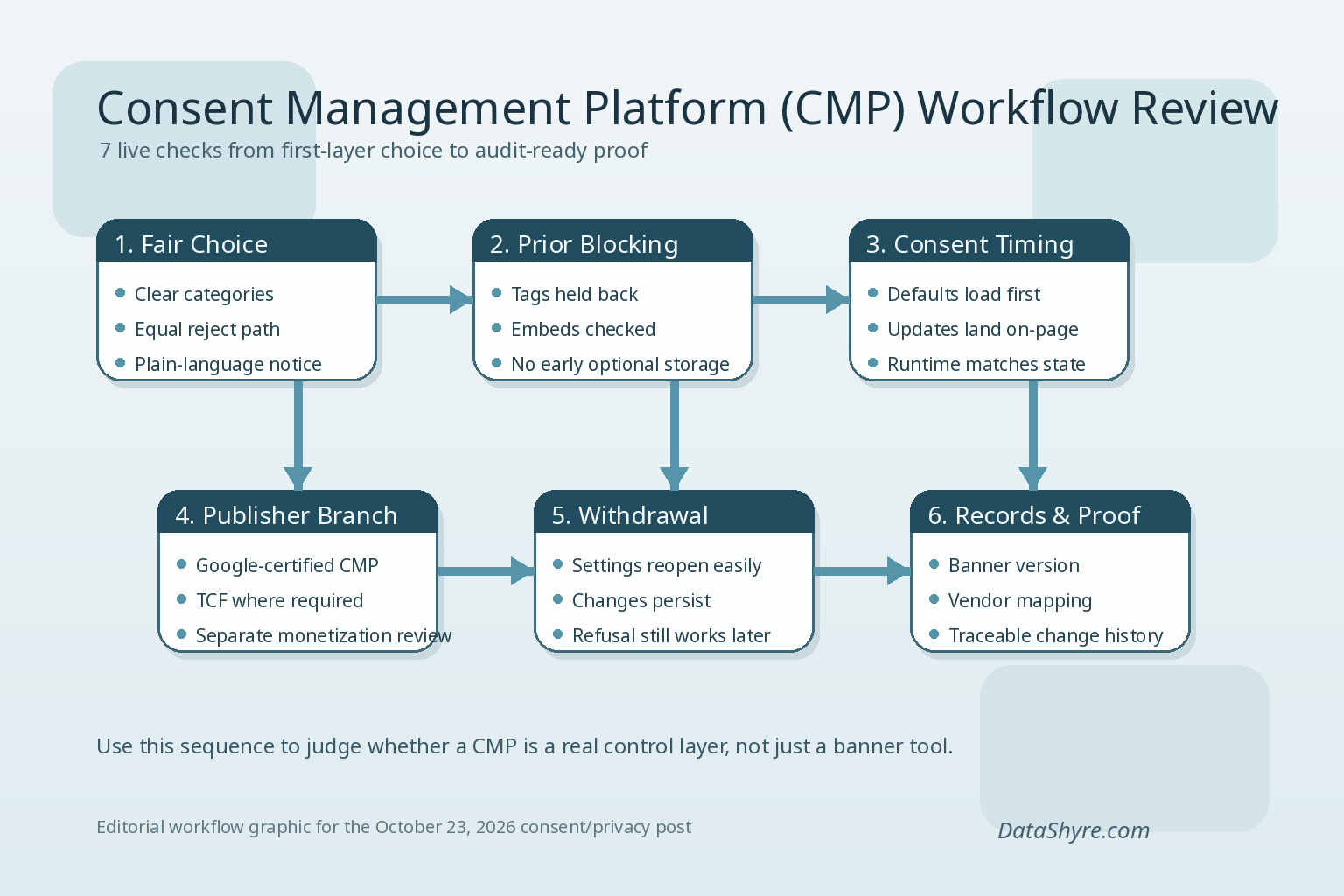
If I were evaluating a consent management platform (CMP) today, I would do it in this order:
- inspect the first-layer choice on desktop and mobile;
- test prior blocking on the templates most likely to leak;
- verify denied defaults and updates reach downstream tools in time;
- separate the publisher branch from the broader legal review;
- check whether regional exception or objection logic is actually configurable and understandable;
- review category and vendor mapping with the live page open;
- save proof another team can still verify next month.
That sequence usually tells you more than a vendor demo ever will.
FAQ
Is a consent management platform just a cookie banner?
No. A banner is only the visible layer. A real consent management platform (CMP) should also influence prior blocking, consent signaling, withdrawal handling, regional branching, and records.
Does Google certification mean the CMP is legally compliant everywhere?
No. Google’s own help materials say certification is tied to Google’s criteria and does not decide full compliance with applicable privacy laws for you.
Can one CMP handle both general consent and Google publisher monetization needs?
Sometimes, yes, but you still need to test those as separate branches. Google’s publisher requirement is a specific monetization rule, not a substitute for your broader runtime and legal review.
Bottom line
In 2026, the right definition of a consent management platform (CMP) is not “software that shows a banner.”
It is software that helps a team present a fair first choice, hold optional technologies back, propagate the right signal in time, handle the right regional branch, and preserve proof after the stack changes.
The strongest outcome for consent management platform (cmp is not a prettier banner. It is a cleaner control path from user choice to technical enforcement.
Sources
- European Commission, legal grounds for processing data: https://commission.europa.eu/law/law-topic/data-protection/information-business-and-organisations/legal-grounds-processing-data_en
- CNIL, dark patterns in cookie banners: https://www.cnil.fr/en/dark-patterns-cookie-banners-cnil-issues-formal-notice-website-publishers
- ICO, guidance on the use of storage and access technologies: https://ico.org.uk/for-organisations/direct-marketing-and-privacy-and-electronic-communications/guidance-on-the-use-of-storage-and-access-technologies/
- ICO, what are the exceptions: https://ico.org.uk/for-organisations/direct-marketing-and-privacy-and-electronic-communications/guidance-on-the-use-of-storage-and-access-technologies/what-are-the-exceptions/
- Google for Developers, set up consent mode on websites: https://developers.google.com/tag-platform/security/guides/consent
- Google AdSense Help, set up and manage your consent management platform (CMP): https://support.google.com/adsense/answer/7670013
- Google AdSense Help, Google consent management requirements for serving ads in the EEA, the UK and Switzerland (for CMPs): https://support.google.com/adsense/answer/13554020
—
Published: October 23, 2026. Updated using current official regulator and platform materials available at publication time.